
Dauphin County Death Records
Dauphin County sits at the heart of Pennsylvania, home to the state capital of Harrisburg. Death records for this county reach back to 1893, with local vital records predating statewide registration. The county seat holds a wealth of historical documents, including cemetery inventories, will books, and birth and death registers maintained by the Dauphin County Historical Society. Researchers tracing family histories in central Pennsylvania often find this county's collections among the most comprehensive in the region.
Dauphin County Quick Facts
Dauphin County Death Records Overview
Dauphin County has maintained vital records since 1893, giving researchers access to more than a century of local death documentation. The county was established in 1785, and records from as far back as that founding year survive in various forms. Death and birth registers from 1893 to 1906 represent the core local collection before the state assumed control of vital records registration. After 1906, the Pennsylvania Department of Health became the primary custodian of statewide death certificates.
The Register of Wills office is located at 101 Market Street in Harrisburg, on the second floor of the courthouse. This office handles probate and estate matters, while the Dauphin County Historical Society maintains the historical birth and death registers. Marriage records at the county level go back to 1887, predating even the local vital records system. Genealogists working on Dauphin County lines benefit from having multiple repositories within a short distance of each other in Harrisburg.
Note: Records created after 1906 are held by the Pennsylvania Division of Vital Records, not the county courthouse.
Dauphin County Historical Society Archives
The Dauphin County Historical Society operates the Alexander Family Library and Archives, one of the most valuable resources for death record research in central Pennsylvania. The library holds the Registry of Dauphin County Births from 1893 to 1906 and the Registry of Dauphin County Deaths from the same period. These bound volumes contain handwritten entries that predate formal state registration and are often the only surviving record for many families from this era.
Beyond vital records, the Historical Society has assembled an impressive collection of cemetery inventories. These inventories document burial sites across the county and often contain death dates, birth dates, and family relationships not found in official records. Will book extracts covering the years 1785 to 1827 round out the research holdings and make it possible to trace family connections in the county from its earliest days. The library also maintains newspaper collections, family files, and local history references that support genealogical work.
Researchers can reach the library by email at library@dauphincountyhistory.org or by phone at 717-233-3462. The Alexander Family Library welcomes public visitors for in-person research.
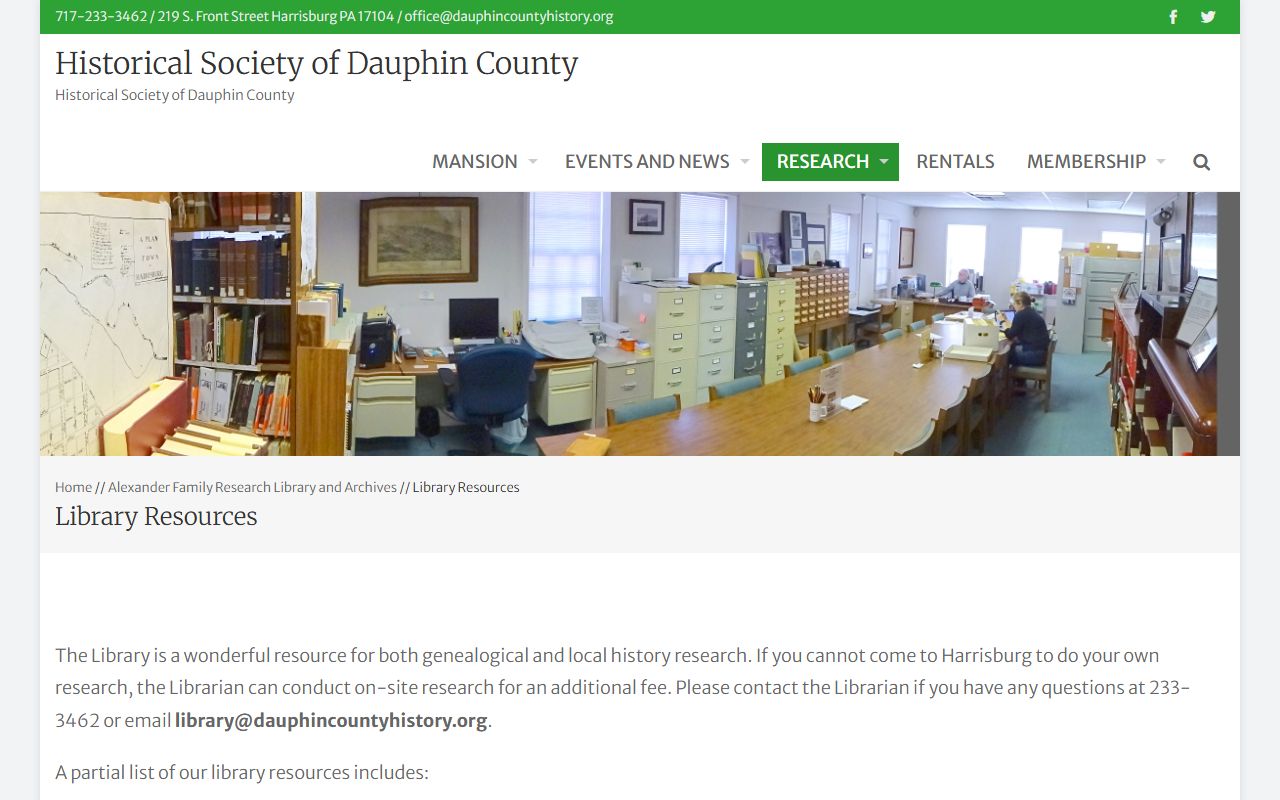
The Historical Society also serves as an entry point for researchers new to Dauphin County genealogy. Staff can point visitors toward the right collections and help interpret older handwritten entries in the death registers. This kind of local expertise is hard to replicate through online searches alone.
Register of Wills and Probate Records
The Dauphin County Register of Wills maintains probate records that often complement death record research. When someone died and left an estate, a will or administration filing would typically follow. These records name heirs, list assets, and provide details about the deceased that death certificates alone may not include. Probate filings sometimes identify a person's exact birth date, names of surviving relatives, and the date and place of death.
Dauphin County probate records extend back to the county's founding in 1785, making this one of the longer-running document collections in the region. Will books from 1785 to 1827 have been extracted and indexed, helping researchers work through older handwritten documents more efficiently. The office is open during regular business hours and staff can assist with record requests in person or by phone.
| Office | Dauphin County Register of Wills 101 Market Street, 2nd Floor Harrisburg, PA 17101 Phone: 717-780-6500 |
|---|---|
| Hours | Monday–Friday, regular business hours |
| Records | Probate records from 1785; birth/death registers 1893–1906; marriage records from 1887 |
Pennsylvania State Death Records Access
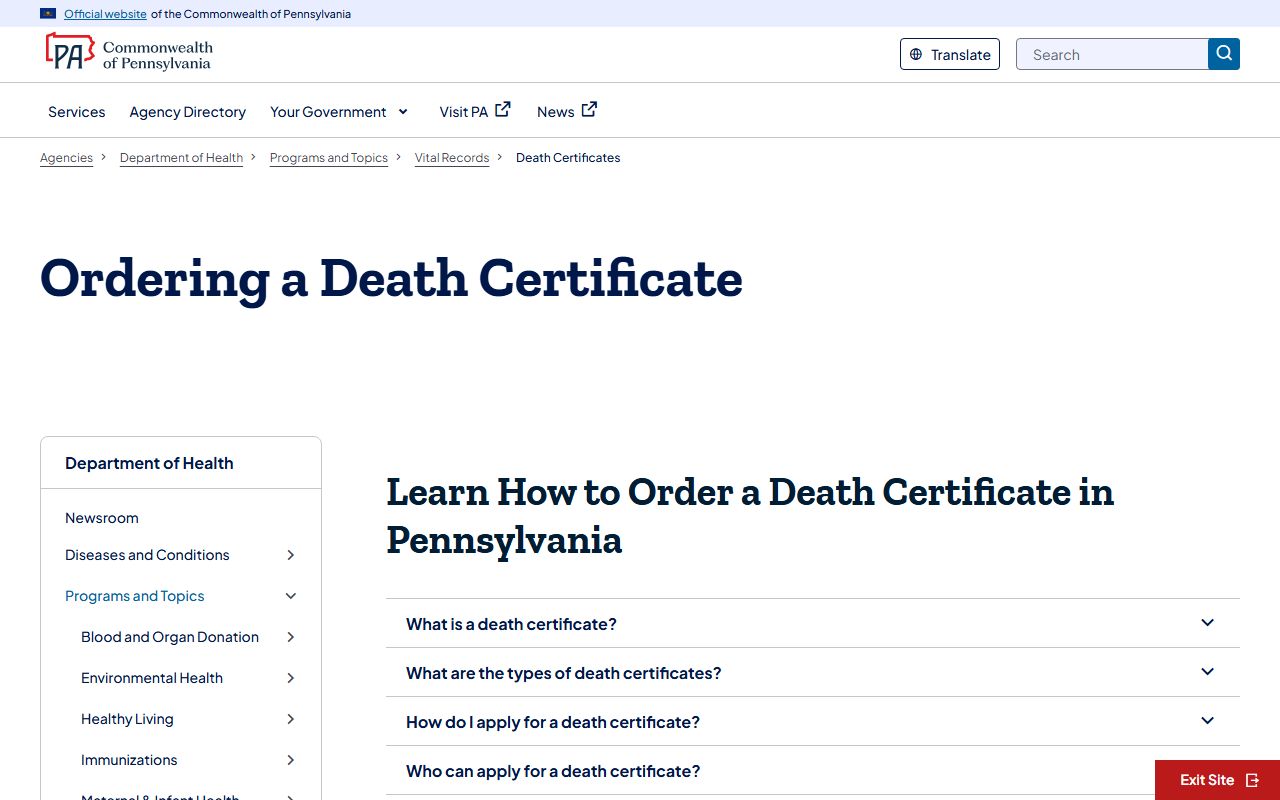
Death certificates issued after 1906 fall under the custody of the Pennsylvania Division of Vital Records. Harrisburg serves as the state capital and is home to many of the administrative offices that oversee statewide vital records. The Division processes requests for certified copies of death certificates and also maintains the official death index that genealogists use to locate records.
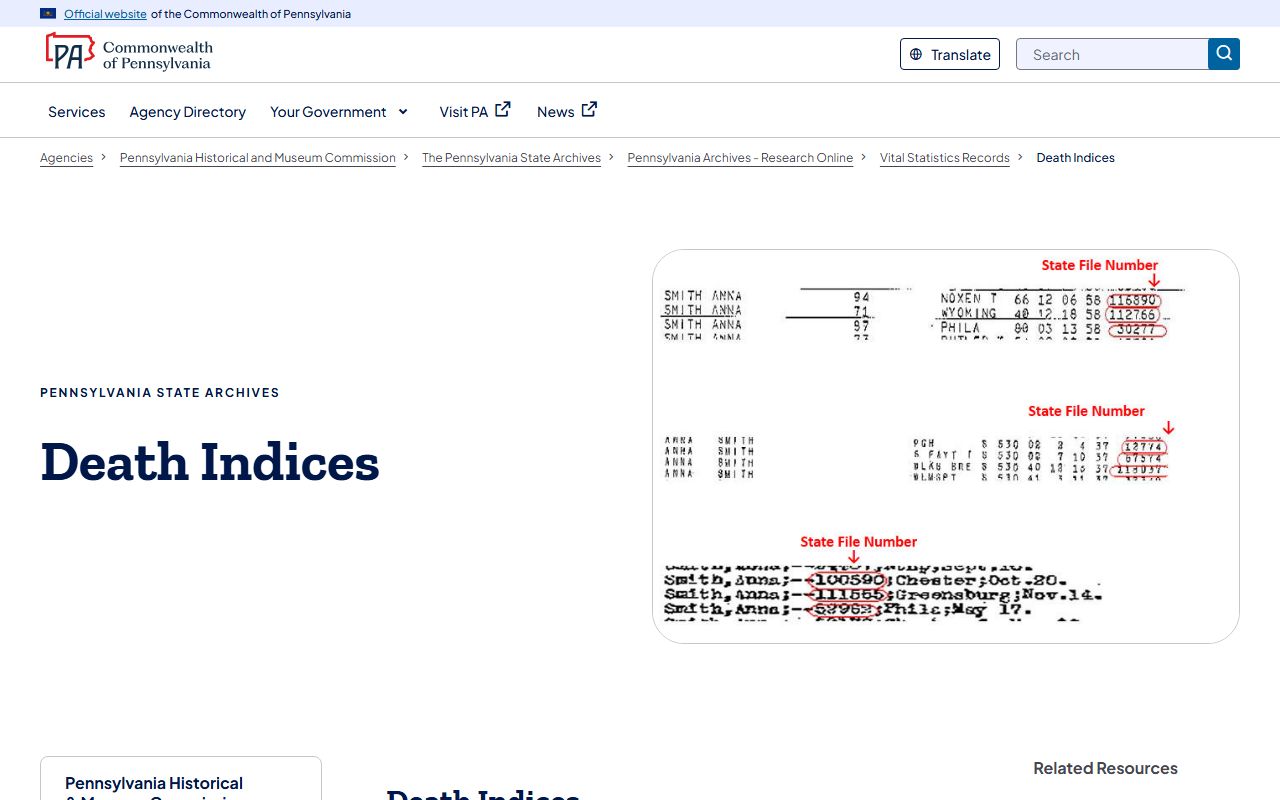
The Pennsylvania death indices are searchable online through the State Archives and cover deaths registered from the start of statewide record-keeping. Certified copies cost $20 per certificate and can be ordered through the state's online portal at mycertificates.health.pa.gov or through VitalChek. Mail requests go to the Division at P.O. Box 1528, New Castle, PA 16103. Phone inquiries can be directed to 724-656-3100.
Note: Genealogical access rules differ from those for certified copies. Records more than 50 years old have broader availability for family history research under Pennsylvania law.
The state also makes older vital records available through the Pennsylvania State Archives. Digitized indexes and microfilmed records cover much of the early statewide collection and can be searched remotely before planning an in-person visit.
Dauphin County Genealogy and Vital Records Research
Dauphin County is one of the more rewarding counties in Pennsylvania for genealogical research. Its role as the state capital means that many official records were created and preserved with unusual care. The county was formed from Dauphin County in 1785, and the documentary record from that founding year forward is remarkably intact.
Researchers working on pre-1893 deaths will need to turn to indirect sources. Church records, cemetery surveys, and newspaper obituaries can fill gaps left by the absence of official vital records before the county began its own registration system. The Dauphin County Historical Society has assembled many of these indirect sources into a single searchable archive, making it easier to find deaths that were never formally registered. FamilySearch also offers free access to many Pennsylvania vital record indexes, including Dauphin County collections.
The county's location in central Pennsylvania means that it borders several other well-documented counties. Researchers often find that families moved between Dauphin and neighboring Lebanon, Cumberland, and Perry counties, so checking adjacent county records is always a good strategy.
Harrisburg and Dauphin County Death Certificates
Harrisburg, as both the county seat and state capital, generated a significant number of death records throughout the late nineteenth and early twentieth centuries. The city's growth during the industrial era and its role as a government and transportation hub brought people from across the state. This migration history means that a death record found in Harrisburg may document someone whose family roots lie in another Pennsylvania county entirely.
City records and county records were not always kept separately in Dauphin County during the early registration period. Researchers should check both the county-level registers and any surviving municipal records when searching for a Harrisburg death. Obituary archives at local libraries and newspaper digitization projects have made it easier to locate deaths that may not appear in the formal vital records system.
Note: The Pennsylvania State Archives holds microfilm copies of many county-level records and can be searched online before visiting in person.
Nearby Counties
Dauphin County shares borders with several counties that also have strong historical records. Researchers often find family connections crossing into these neighboring jurisdictions.