
Cumberland County Death Records and Archives
Cumberland County has one of the oldest and most varied death records collections in Pennsylvania. Probate records in Carlisle date to 1750, the year the county was created from Lancaster County, and the Cumberland County Archives holds institutional records that go far beyond standard vital statistics. The Archives preserves poorhouse records from 1812 through 1948, prison records from 1775 through 1896, and a unique collection of anatomical board records documenting unclaimed bodies from 1921 through 1937. Death registration in Cumberland County began in 1894 -- one year later than most Pennsylvania counties -- a distinction researchers should keep in mind when searching for early records.
Cumberland County Quick Facts
Cumberland County Register of Wills Death Records
The Cumberland County Register of Wills in Carlisle holds local birth and death records from 1894 through 1906, along with marriage records from 1885 and probate records dating back to 1750. The 1750 probate collection is among the oldest county-level records in Pennsylvania and represents 276 years of continuous documentation of property transfers, estate settlements, and family relationships at death.
Cumberland County began local death registration in 1894, one year later than most other Pennsylvania counties, which started in 1893. This one-year gap is important: if you are searching for a Cumberland County death from 1893, no official county death record exists. The county was still operating without a formal registration system that year. Researchers looking for 1893 deaths in Cumberland County should rely on church records, cemetery data, and newspaper obituaries instead.
Online records at the county level are accessible from 1978 to the present through the county's own search system. This digital access covers the modern period and supplements the physical records held at the Carlisle courthouse.
| Office | Cumberland County Register of Wills 1 Courthouse Square Carlisle, PA 17013 |
|---|---|
| Hours | Monday–Friday, 8:30 AM–4:30 PM |
| Records | Birth and death records 1894–1906; marriage records from 1885; probate records from 1750; online records 1978 to present |
Note: Cumberland County death registration begins in 1894, not 1893. Any research expecting an 1893 record should check church and cemetery sources instead of the courthouse.
Cumberland County Archives Unique Collections
The Cumberland County Archives holds several collections that are unusual even by Pennsylvania standards. Poorhouse records from 1812 through 1948 document residents of the county's almshouse -- individuals who died in poverty or without family to care for them. These records often contain the only official documentation of death for people who might not appear in any other vital records collection. For researchers tracing ancestors who lived on the margins of 19th and early 20th-century society, poorhouse records can be irreplaceable.
Prison records from 1775 through 1896 cover more than a century of incarceration in Cumberland County. Some of these records document deaths in custody, and all can help researchers identify individuals who were incarcerated in Carlisle during their lifetime. The records extend back to the Revolutionary War era, making them useful for historical research well beyond genealogy.
The anatomical board records from 1921 through 1937 are among the most unusual death-related records held anywhere in Pennsylvania. These documents record unclaimed bodies -- individuals who died without family to claim them -- that were donated to medical education under Pennsylvania's anatomical board laws. Each entry typically identifies the deceased by name when known, along with circumstances of death, date, and the institution that received the remains. For researchers whose ancestor simply vanished from the historical record, the anatomical board files may hold the answer.
Note: The Cumberland County Archives anatomical board records from 1921 to 1937 document unclaimed bodies provided to medical institutions -- a unique source for tracing individuals who died without family in Cumberland County during that period.
Certified Cumberland County Death Certificates
For Cumberland County deaths from 1906 onward, certified copies are available from the Pennsylvania Division of Vital Records at P.O. Box 1528, New Castle, PA 16103-1528. The state charges $20 per certified copy. Online orders go through mycertificates.health.pa.gov, and phone inquiries can be directed to (724) 656-3100. VitalChek provides an authorized third-party ordering option for those who prefer online processing with a service fee.
Access to Cumberland County death records less than 50 years old is restricted under 35 P.S. §450.801. The statute limits these records to immediate family members, legal representatives, and qualified applicants who can demonstrate a lawful need. Records 50 years old or older are open for genealogical research without restriction. The guidelines under 28 Pa. Code Chapter 1 establish the administrative procedures the Division of Vital Records follows when processing restricted-record requests.
The image below, from the Cumberland County Register of Wills page at the county government website, illustrates the local record-keeping infrastructure for Cumberland County death records and vital statistics.
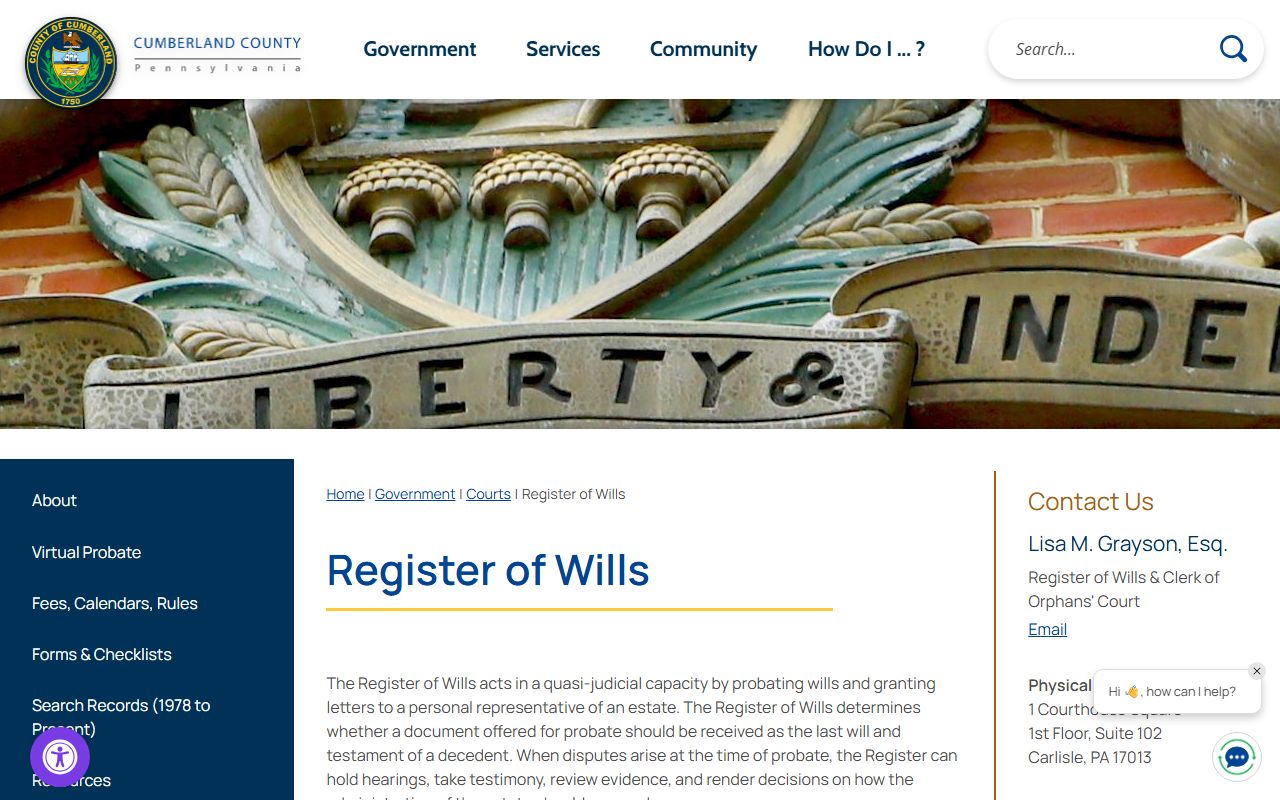
The Register of Wills office is the starting point for all Cumberland County research involving pre-1906 death records, marriage records, and the county's extensive probate collection dating to 1750.
Pennsylvania State Archives and Cumberland County Records
The Pennsylvania State Archives in Harrisburg holds Cumberland County death certificates from 1906 through 1975. The Archives' online death index is searchable at no cost and is the recommended first step before submitting any paid records request. By confirming a record's existence in the index first, researchers avoid paying for records that may not exist or may be recorded under an unexpected name variant.
Cumberland County's probate records reaching back to 1750 make it one of the most historically deep repositories in Pennsylvania. Estate inventories, will filings, and guardian appointments from the 18th century can establish death dates and surviving heirs for colonial-era Cumberland County residents who died long before any vital records system existed. For research on pre-1850 family lines, these probate files are often the primary evidence of death.
The Ancestry PA portal gives online access to some digitized Pennsylvania vital records through a partnership between the State Archives and Ancestry. Some Cumberland County materials are accessible through this portal, and access is free at Pennsylvania public libraries.
Cumberland County History and Death Records Context
Cumberland County was created in 1750 from Lancaster County. Carlisle, the county seat, is a historic military town and the site of the U.S. Army War College. The town also hosted the Carlisle Indian Industrial School from 1879 to 1918, one of the largest of the government-run boarding schools for Native American children. Deaths at the school were documented in school records that are now held by the National Archives and Records Administration; these records are separate from the general Cumberland County death records system but are relevant for researchers tracing Native American family history connected to Carlisle.
The county's long history -- it has existed continuously since 1750 -- means that Cumberland County death records span more historical periods than almost any other Pennsylvania county outside the original three. The probate records alone cover the French and Indian War era, the American Revolution, the early national period, and the entire 19th century before formal death registration even began. Researchers working on deep genealogies in this part of Pennsylvania will find Cumberland County records at virtually every level of their research.
Carlisle's role as a military center also means that military pension files and service records held at the National Archives can supplement local death records for veterans who lived and died in Cumberland County. Many 18th and 19th century veterans who received federal pensions were residents of Cumberland County, and their pension files often contain detailed death information.
Note: Cumberland County's probate records from 1750 are among the oldest county-level records in Pennsylvania and can document deaths for colonial-era residents centuries before formal death registration began.
Pre-Registration and Supplementary Cumberland County Sources
For Cumberland County deaths before 1894, church records are the most consistent source. The county's German Lutheran, Reformed, and Presbyterian congregations kept burial registers going back into the colonial period, and many have been microfilmed by FamilySearch. The FamilySearch Pennsylvania Vital Records wiki identifies specific Cumberland County collections available at no cost online.
Cemetery transcription projects for Cumberland County have been conducted by local genealogical volunteers over many decades. Several dozen Cumberland County cemeteries have been transcribed and indexed. These records can establish approximate death dates for individuals who died before registration began and for whom no church record survives.
Federal mortality schedules from 1850 through 1880 provide census-era death data for Cumberland County. These schedules are available through the State Archives and FamilySearch. Combining mortality schedules with the county's extensive probate records and poorhouse files at the Archives gives Cumberland County researchers a broader toolkit than most Pennsylvania counties can offer.
The CDC's Where to Write page for Pennsylvania is a useful overview resource for researchers who are beginning Cumberland County death records research and want to understand the full state vital records framework before diving into county-specific sources.
Nearby Counties
Cumberland County is located in south-central Pennsylvania, near the state capital. Researchers may need to extend searches to neighboring counties for families who lived near county boundaries.