
Allegheny County Death Records and Vital Records
Allegheny County death records span more than two centuries of Pittsburgh history, from the city's earliest settlement days to the present. The county holds pre-1906 death registrations at the Register of Wills, while records from 1906 forward are managed by the Pennsylvania Division of Vital Records. The Carnegie Library of Pittsburgh adds another layer of access with its deep collection of newspaper death notices and city death registers. This page explains where to find Allegheny County death records and how to request copies for genealogy or official purposes.
Allegheny County Quick Facts
Allegheny County Register of Wills Death Records
Allegheny County was formed in 1788 from portions of Washington and Westmoreland counties, making it one of the older counties in western Pennsylvania. The Register of Wills and Clerk of Orphans' Court is located in the City-County Building at 414 Grant Street, Pittsburgh, PA 15219. This office holds probate records dating back to 1789. It also holds the county's official birth and death registrations from 1893 through 1905, a period before the Commonwealth took over statewide record-keeping.
Marriage records from 1885 forward are also on file here. Researchers looking into Allegheny County deaths in the late 1800s and early 1900s will find the Register of Wills office to be the primary county-level source. The office can be contacted for guidance on how to search records or request copies of historical filings.
| Office | Allegheny County Register of Wills 414 Grant Street, Pittsburgh, PA 15219 Phone: Allegheny County Government |
|---|---|
| Hours | Monday–Friday, 8:30 AM–4:30 PM |
| Records | Birth and death records 1893–1905; marriage records from 1885; probate records from 1789 |
Note: The Allegheny County Register of Wills holds pre-1906 vital records only; all deaths from 1906 onward must be requested from the Pennsylvania Division of Vital Records.
Carnegie Library Pittsburgh Death Records Collection
The Carnegie Library of Pittsburgh is one of the most valuable resources for Allegheny County death records research. Its Pennsylvania Department, located at 4400 Forbes Avenue, Pittsburgh, PA 15213, holds a collection that few other libraries can match. The library's holdings include Pittsburgh City directories beginning in 1813 and a newspaper death notice index covering 1787 through 1913 and again from 1969 to the present. That gap in the index is worth knowing before you begin your search.
The library also holds microfiche copies of Allegheny County birth and death registers that predate 1906. Pittsburgh Death Registers covering 1870 through 1905 are part of this collection, as are Allegheny City Death Registers for 1875 through 1907. Allegheny City was a separate municipality that merged with Pittsburgh in 1907, so its death records are kept apart from the Pittsburgh city registers. Researchers looking for deaths in what is now the North Side of Pittsburgh should check the Allegheny City series specifically.
The Carnegie Library charges fees for search and copy services. Fees range from $5 to $17, and orders are limited to four names per request. This limit applies to mail-in genealogy requests; in-person researchers can search more broadly during a library visit.
The image below comes from the Carnegie Library of Pittsburgh's website, which describes the library's genealogy collections and services for Allegheny County death records research.
Carnegie Library of Pittsburgh provides access to historical death registers, newspaper indexes, and city directories covering Allegheny County from the late 1700s through the early 1900s.

In-person visits to the Carnegie Library allow researchers to search microfilm death registers for Pittsburgh and Allegheny City without the four-name order limit that applies to mail requests.
State Death Certificates for Allegheny County
Pennsylvania began statewide death registration in 1906. All Allegheny County death certificates from that year through the present are held by the PA Division of Vital Records. Certified copies can be ordered online at mycertificates.health.pa.gov for $20 each, plus a $10 online processing fee. Mail orders sent directly to P.O. Box 1528, New Castle, PA 16103-1528 avoid the online fee. The Division's phone number is (724) 656-3100.
For non-certified copies of Allegheny County death certificates from 1906 through 1970, the Pennsylvania State Archives is an alternative source. The Archives holds death certificates for this period statewide, including all Allegheny County deaths. Access is governed by 35 P.S. §450.801, which restricts records less than 50 years old to qualified applicants. Once a certificate passes the 50-year mark, it becomes more broadly accessible for genealogy purposes.
The image below is from the Pennsylvania Department of Health's vital records page, which is the official gateway for ordering Allegheny County death certificates from 1906 to the present.
Pennsylvania Department of Health vital records handles all certified death certificate orders for Allegheny County deaths from 1906 onward.

The state vital records office in New Castle processes all Allegheny County death certificate requests regardless of which part of Pittsburgh or the county the death occurred in.
Note: Genealogy mail requests to the Division of Vital Records cover a 10-year date range for $25; this can be useful when the exact year of an Allegheny County death is uncertain.
Allegheny County Research Guide and Genealogy Resources
The Allegheny County Research Guide PDF from Mt. Lebanon Library is a practical starting point for anyone working through Pittsburgh genealogy. It outlines the major record repositories, explains which office holds which type of record, and gives researchers a clear roadmap for tackling Allegheny County death records. The guide is free to download and covers topics from pre-1906 county records all the way through modern certificate orders.
The FamilySearch Allegheny County genealogy page lists free collections that can be searched online. Many of these collections overlap with the Carnegie Library holdings but offer keyword search capabilities that microfilm does not. FamilySearch is especially useful for researchers who cannot travel to Pittsburgh in person.
Pennsylvania State Archives Allegheny County Death Records
The Pennsylvania State Archives holds Allegheny County death certificates from 1906 through 1975. Online death indices for this period allow researchers to confirm a death before requesting the actual certificate or document image. The Archives' online tools are available to all researchers, and Pennsylvania residents can access Ancestry.com free through the state partnership.
Under 28 Pa. Code Chapter 1, Allegheny County deaths must be registered within 96 hours. This requirement has been in place for many decades, so researchers should generally expect modern records to exist. Gaps in the historical record are more common in the pre-1906 period, when registration was a county responsibility rather than a state one.
The image below comes from the online ordering portal for Pennsylvania death certificates, which is the correct channel for requesting Allegheny County records from 1906 forward.
Pennsylvania's online certificate portal allows researchers to order certified Allegheny County death records directly from the state vital records office.
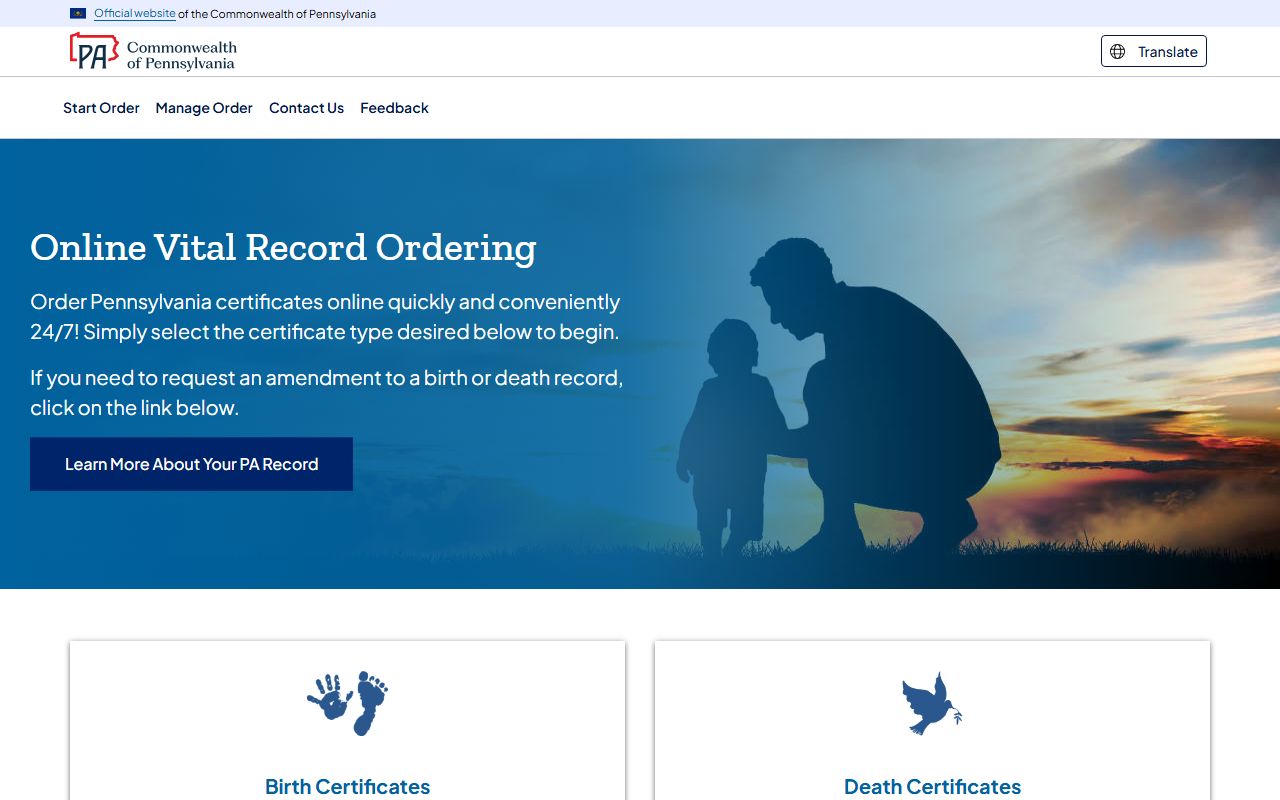
Using the state portal, you can order Allegheny County death certificates for any death from 1906 to the present, provided you meet the eligibility requirements under state law.
Cities in Allegheny County
Pittsburgh is the county seat of Allegheny County and the largest city in western Pennsylvania. Death records for Pittsburgh residents are part of the broader Allegheny County record system, though some city-specific registers exist for the pre-1906 period as described above. Visit the Pittsburgh page for more details on city-level death record resources.
Nearby Counties
Allegheny County sits at the center of western Pennsylvania, surrounded by counties that share similar record-keeping timelines. Many families in the region moved between these counties, so checking neighboring jurisdictions is often worthwhile.